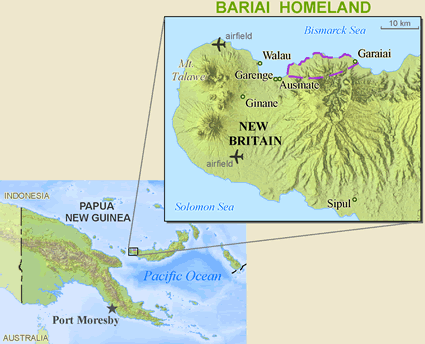
The Bariai are an indigenous people living along the northwest coast of West New Britain Province, particularly east of Cape Gloucester. Their communities are in coastal areas where the sea, mangroves, and nearby forests have shaped their way of life for generations.
They are part of the wider Austronesian-speaking peoples of the Pacific region. The Bariai language, also known as Kabana, belongs to the Oceanic branch of the Austronesian language family and is closely tied to their identity and cultural continuity.
Historically, the Bariai have lived in relatively small, close-knit communities. Their traditions, knowledge, and history have been preserved through oral transmission. Over time, contact with missionaries and broader national influences has brought change while many aspects of their traditional way of life remain.
Daily life for the Bariai is closely connected to the coastal environment. Fishing plays a major role in providing food, along with gardening and the use of forest resources. The surrounding land and sea provide the materials needed for housing, tools, and daily living.
Villages are typically organized around extended families, with strong kinship ties shaping leadership and responsibilities. Cooperation among families is essential, and respect for elders helps guide community decisions and preserve cultural knowledge.
Homes are constructed from locally available materials suited to the tropical climate. The Bariai language remains central to identity and daily communication, while Tok Pisin may also be used for interaction with neighboring groups or in wider settings.
Cultural life includes storytelling, communal gatherings, and the passing down of traditions that reinforce shared identity and continuity across generations.
The Bariai are identified primarily with Christianity, and churches are well established within their communities. Many would describe themselves as followers of Jesus Christ, and Christian teaching has had a strong influence on daily life.
At the same time, some traditional beliefs may still be present in the background, particularly in how certain individuals understand spiritual matters or interpret life events. These perspectives vary and may exist alongside Christian faith.
The New Testament has been translated into the Bariai language, and additional scripture portions are available. This provides an important foundation for personal faith, teaching, and church life.
Although Christianity is widespread among the Bariai, there remains a need for deeper spiritual maturity and a clearer understanding of Scripture. Continued discipleship and faithful teaching are important so that belief in Christ is firmly grounded in God's Word.
Church leaders would benefit from encouragement and sound biblical training to help them guide their communities effectively. Strengthening families in their understanding of Scripture is also essential for passing the faith to future generations.
Access to scripture in forms that are widely used and clearly understood remains important for continued growth.
Like many coastal communities, they also face challenges related to education, economic opportunity, and maintaining their language and identity in a changing world.
Pray that the Bariai would grow in a deep and personal relationship with Jesus Christ, rooted firmly in the truth of scripture.
Pray for church leaders to be strengthened, equipped, and faithful in teaching God's word.
Pray that the New Testament and available scripture portions would be widely read, understood, and lived out.
Pray for families to be grounded in biblical truth and for younger generations to follow Christ wholeheartedly.
Pray for unity among believers and a strong witness that reflects the transforming power of the gospel.
Scripture Prayers for the Bariai in Papua New Guinea.
| Profile Source: Joshua Project |